
For 25 years, I did not draw anything.
I only picked up drawing—or, more precisely, learning to draw—two years ago. I took a drawing class when I was 39 weeks pregnant with my second child. I had already started my self-declared maternity leave and, for the first time in a long while, felt like there was finally a bit of space in my life to try something beyond work—something lighter.
At the time, my oldest daughter was three. She absolutely loved drawing, and I thought it would be fun if we could draw together.
Fast-forward to yesterday, I took my first watercolor class at Crissy Field, one of my favorite places.
I expected to learn watercolor. Instead, I walked away learning something about myself.
My teacher, Marco, showed up wearing a bright orange jacket, which made him very easy to spot among many people scattered across Crissy Field on a sunny afternoon.
Instead of calling it a private lesson, Marco describes it as a “Personal Expedition: Find Your Voice in Watercolors.”
I didn’t think much of that phrase at first. By the end of the class, I understood what he meant.
I realized that before I could draw anything, I first had to observe—and not just glance, but really observe.
“What’s the color of the Golden Gate Bridge?”
If you had asked me before the class, I would have answered immediately: bright orange. Maybe red.
But as I sat there looking at it, I realized it was neither. At that moment, it looked like a mix of gray, blue, and dark burgundy.
The water wasn’t one shade of green either. On my left, it reflected a lighter green; on my right, it became a deeper, darker green. Even the sand had two distinct sections: the upper part was a lighter yellow-brown, while the area where we were sitting was darker and more brownish.
Then there were the clouds. I had never realized how quickly they changed. Every time I looked up, they seemed to have shifted into a new shape or moved somewhere else.
Normally, my mind is occupied with thoughts. Too many thoughts. But for that hour, there was only what was in front of me.
When it was time to paint the bay, Marco asked me to move my brush in one long, continuous horizontal stroke from one side of the paper to the other.
“Just do one big wash.”
“One big swoosh across the entire page. Don’t lift your brush. Don’t stop and paint it bit by bit.”
I paused.
Ugh. What if I messed it up?
With watercolor, I couldn’t erase the stroke or cover it up as I could with acrylic.
Marco had a gentle way of encouraging me. He demonstrated the stroke on his own paper first, then let me practice it on his paper.
Eventually, I felt ready. I made one big swoosh across the page without stopping.
“Why can’t I just do it bit by bit?” I asked him later.
“Because it shows where you hesitated,” he said. “And the painting won’t look right.”
I didn’t fully understand what he meant. But when I looked at my paper, I was pleasantly surprised by how it had taken shape.
It was not perfect by any means. There were pockets of white that I hadn’t covered with paint, and some parts of the wash were darker because I had pressed harder with the brush.
But for the most part, it worked. I was happy with how the experiment had turned out.
I realized that I wasn’t just learning about watercolor. Watercolor was teaching me a new way of working and operating.
My husband often says, “You like to be in control.” And I know he is right.
Throughout my life, my instinct has been to plan carefully, do all the research, and control whatever I can.
Honestly, it can be exhausting. But I am so used to operating this way, and it has served me well in many parts of my life.
Watercolor invited me to try something completely different: make one big stroke, let the brush move, let the water spread, and let the colors mix wet on wet. Then see what happens.
I was surprised by how much I enjoyed it.
Afterward, I looked at my first watercolor and felt delighted by how it had turned out—not because it was perfect, but because it had taken shape when I resisted the temptation to control every detail and allowed myself to let go.
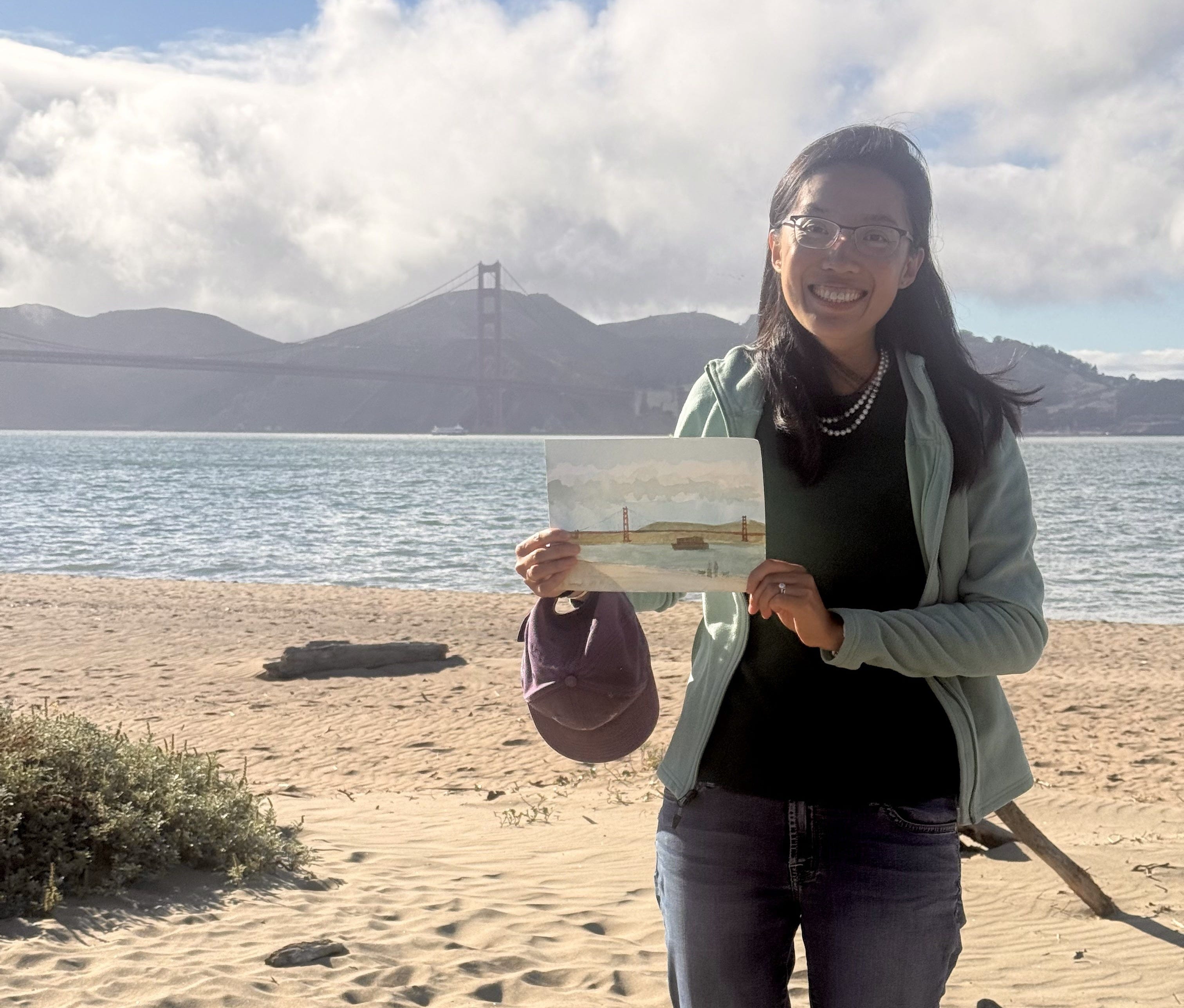
I started to see that letting go of some control is exactly what gives watercolor its magic.
The water moves, the colors mix, and something natural emerges that I could never have planned precisely.
For that hour, I was fully present—not anticipating the outcome, but simply observing, trying, and letting the painting unfold.
It made me wonder: Where else in my life could I let go a little more? Where could I trust more what unfolds, stay present, and simply have fun?
I don’t know the answer yet. But perhaps watercolor is a good place to begin—one big swoosh at a time.
So here is a question for both of us:
What is one thing—just one thing—you could loosen your grip on this week, trust your own brushstroke, and simply see what happens?
I’d love to hear your answer! Feel free to leave a comment, or send me a quick reply from email.
This piece is so beautifully written and really made me think about my life and the places where I might be trying to grip control too tightly... Reading about your painting experience made me want to take an art class myself! Thank you for this inspiring read. Where are you going to hang your beautiful painting?